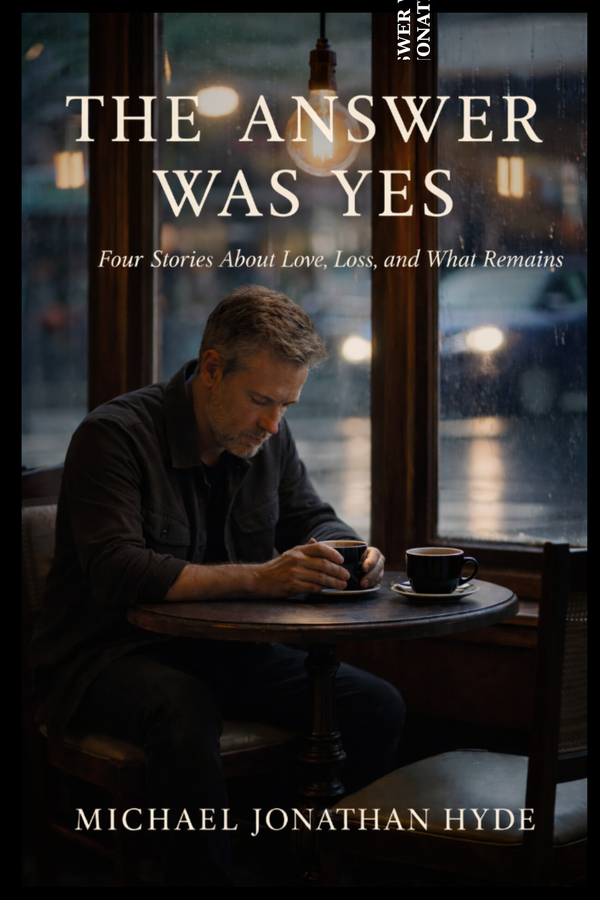
What Was Left Unsaid
The Answer Is Yes
My name is Claire Ashworth. For twenty-three years I wrote for the Millbrook Gazette, a small paper in a small city that most people have never heard of and never will. I covered town council meetings and high school graduations and the occasional tragedy that reminded everyone that small cities are not insulated from the world, just quieter about it. I was good at my job. I believed in it.
I am sixty-one years old now. I have a house with too many books in it and a cat named after a president and a daughter in Portland who calls me every Sunday whether or not either of us has anything particular to say. I drink my coffee black. I sleep well, which I did not always do.
I am telling you these things because what I am about to write will sound, at certain points, like the work of someone who should not be trusted. I want you to know me a little before that happens. I want you to understand that I am a practical woman. I have never been given to fantasy or drama or the kind of wishful thinking that invents meaning where there is none.
What happened to me did not feel like fantasy. It felt like the most real thing that has ever happened to me, and I have been carrying it for years, and I have decided that carrying it is no longer enough.
So.
This is the story of a man named Thomas, and a woman named Anna, and what Anna did after she died.
And this is the story of what I did about it.
Chapter One
The Way They Were
There are couples you notice.
Not because they are loud or beautiful or doing anything remarkable, but because of the quality of attention they pay each other. The way one of them will say something small and the other will smile before the sentence is finished because they already know where it's going and they love where it's going. The way they occupy a room together without occupying it together — each doing their own thing, reading or thinking or watching the street — and yet somehow always aware of the exact location of the other. Like a pair of planets with their own quiet gravity.
Thomas and Anna were that kind of couple.
They had met the way most people meet now — through friends, through coincidence, through the ordinary machinery of two lives moving through the same city at the same speed until they finally intersected. He had been standing in someone’s kitchen at a party he almost hadn’t gone to, holding a drink he didn’t want, talking to someone he didn’t know about something he couldn’t now remember, when Anna walked in from the other room and said something that made everyone laugh and he had thought — oh. Just that. The simplest possible recognition. Oh. There you are.
He had loved her for three years before he found the courage to say so out loud. By then she already knew.
That was Anna. She knew things before they were said. She had a quality of attention that made you feel seen in a way that was occasionally uncomfortable and always worth it. She listened the way most people forgot to listen — completely, without preparing her next sentence while you were still finishing yours. Thomas had never felt so consistently understood by another person in his life and he was privately certain he never would again and that certainty had lived in him not as fear but as a kind of wonder.
They had been together four years when this story begins.
Four years of the particular intimacy that builds between two people who have chosen each other past the easy early part and into the real thing — the dailiness of it, the unglamorous ordinary texture of a shared life. The way she left cabinet doors open and he closed them without comment. The way he forgot things she’d told him and she repeated them without irritation, or not much. The way they had stopped needing to fill silence because silence between them had long since become a form of conversation.
And the café on Merchant Street.
That had been theirs from almost the beginning. A corner place, nothing special to look at — six tables, a counter, a woman named Ruth who had worked there since before either of them could remember and who knew their order without being told. They had started going on Saturday mornings and then Thursday mornings too and somewhere along the way it had stopped being something they decided and become something they simply did, the way you breathe, the way you come home.
He always got there first. She was always a little late.
Neither of them ever mentioned it. It was just the shape of them.
On the last Thursday morning of Anna’s life Thomas arrived at the café at eight forty-three, hung his jacket on the back of his chair, and went to the counter to order.
Two coffees. Hers with a little cream, no sugar.
———
He carried them to the window table and sat down and wrapped both hands around his cup and watched Merchant Street do what it always did on a Thursday morning — the delivery truck double parked in front of the hardware store, the woman with the dog that never wanted to walk, the man who ran the dry cleaners standing in his doorway with his arms folded looking at nothing in particular.
Thomas knew all of it without knowing any of it.
He was thinking about the ring.
It was in his jacket pocket, on the back of the chair, three feet away. He’d been carrying it for eleven days. Eleven days of almost. Of looking at her across a table or a room and thinking — now. And then losing his nerve, or the moment would shift, or it would just feel slightly wrong in a way he couldn’t explain.
He wanted it to be right. He wanted her to know, when it happened, that he’d thought about it. That it wasn’t impulse.
He looked at the door.
She was late by twelve minutes now which wasn’t unusual. He drank his coffee. He watched the street. He thought about what he would say — not the words exactly, he’d learned that scripting it was useless, but the feeling he wanted to carry into it. The simple true thing underneath all the nervousness.
I want to keep having Thursday mornings with you. I want that to be the rest of my life.
Something like that. Or nothing like that. He’d know when she walked in. He always knew what to say when she was actually in front of him.
He looked at the door again.
And then movement on the street caught his eye. A flash of her coat — that particular blue he could pick out anywhere — and he felt the small lift in his chest that he’d stopped noticing because it happened every time he saw her and you stop noticing the things that are always there.
She was crossing the street.
She was looking down at her phone, smiling at something, and he thought — I’ll tell her. Today. Right now when she walks through that door before the coffee gets any colder and before I lose my nerve again.
He was already smiling.
He didn’t see the car.
———
He was on his feet before he understood why.
The sound reached him first — not the impact itself, he would never be able to recall that exactly, just the sudden wrongness of it, the way the street changed register in an instant, and his body knew before his mind did and he was moving, the chair scraping back, his hand hitting the table, coffee spilling, none of it mattering.
He was through the door and into the cold air of Merchant Street and he was running.
The blue coat.
He could see it from twenty feet away and he was closing the distance and saying her name and the small crowd that had already gathered parted for him the way crowds part for someone who belongs to the emergency, who has a claim on it, and then he was on his knees on the cold pavement and she was there and she was looking up at him.
Her eyes found his immediately.
That was the thing he would come back to, later, in the sleepless architecture of three in the morning. That her eyes found his immediately. Like she knew he would come. Like she had never doubted it.
Anna, he said.
She looked at him the way she always looked at him. Like he was the fixed point. Like he was the thing that made the room make sense.
Her lips moved.
He bent closer.
Don’t leave me like this.
He took her face in both hands. He said her name again. He said I’m here, I’m right here, I’m not going anywhere. He said it the way you say things when you are bargaining with something that doesn’t bargain, when you are throwing words at the universe and hoping one of them lands.
He felt her go still.
Not all at once. Just — a quality of stillness that was different from any stillness he had known before. A stillness that had finality in it.
Anna, he said again.
But it was just her name now. It wasn’t reaching anyone.
Someone had called for an ambulance. He could hear it coming from somewhere, that distant wail getting closer, and people around him saying things he couldn’t process, and a hand on his shoulder that he shrugged away because he wasn’t leaving, he wasn’t moving, he had told her he wasn’t going anywhere and he meant it even now especially now.
He stayed on his knees on Merchant Street with her head in his hands until they made him move.
———
They were kind to him at the hospital. People were very kind. He noticed that in a distant way — the particular careful kindness of people who are delivering the worst news and know that no amount of kindness makes it deliverable. A doctor. A nurse. Words that came at him like objects thrown from a distance, some of them landing, some of them not.
He sat in a plastic chair in a corridor and stared at the floor.
At some point someone asked if there was anyone they could call. He couldn’t think of a single name. Not because there was no one but because the only person he wanted to call was the reason he was sitting here and the logic of that kept collapsing in on itself every time he tried to think it through.
He didn’t know how much time passed.
Eventually he stood up. He put on his jacket. He felt the ring in his pocket and he stopped there in the middle of the hospital corridor with people moving around him and he just stood with his hand around it, this small thing he’d been carrying for eleven days, this question that had run out of time.
He stood there for a long time.
Then he walked out into the afternoon.
———
He didn’t go home.
He didn’t know where he was going until he was standing outside the café on Merchant Street and then he understood that there was nowhere else. This was the last place. The last morning. He pushed open the door and the warmth of it came at him and the smell of coffee and underneath everything the ordinary sounds of an ordinary Thursday afternoon and none of it knew. The room didn’t know. It was just a room.
Their table was empty. Someone had cleared it.
He sat down in his chair. He looked at the chair across from him. He thought about her coffee sitting there this morning, cooling while he watched the street, cooling while he waited for her, cooling while she was already gone without either of them knowing it yet.
He sat there until the light changed outside and the Thursday crowd thinned and the woman behind the counter began stacking chairs and looked at him with that careful kindness again and he understood it was time to go.
He put on his jacket.
He put his hand in his pocket.
He walked home alone through the early dark of a Thursday evening on Merchant Street and he did not look back.
End of sample
Keep reading the story.
The complete book is available on Amazon.