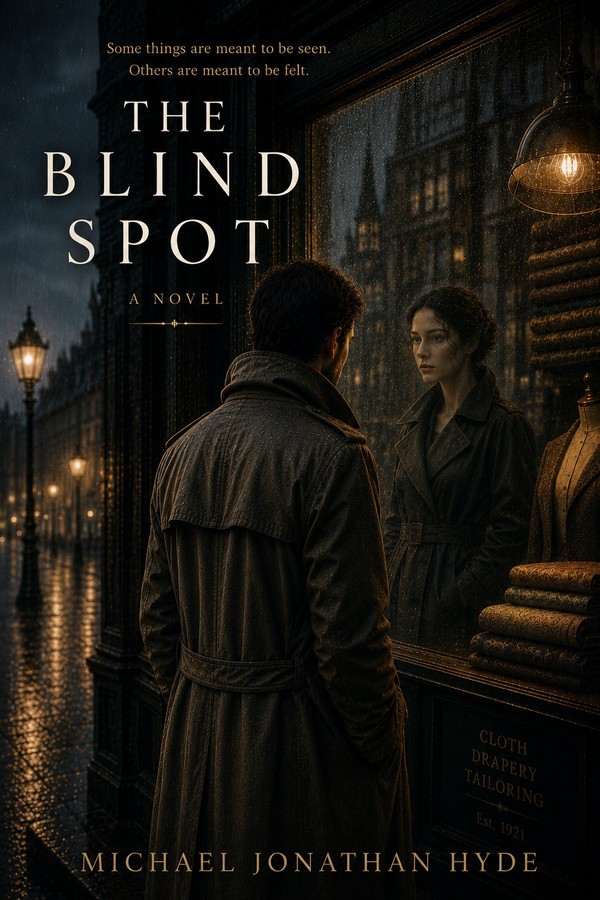
Chapter One
There is a man on a train who is about to drop his book, and Eva is the reason, though if you asked her she could not have told you the moment she'd decided it. She had been near the bookshop, three towns back, standing at the clerk's shoulder in the cold that nobody feels, and the clerk had reached, unasked, for a paper sleeve and slid it over the cover — a little loose, a little careless — and gone on with his day never knowing he'd been leaned on.
That was most of it. The rest was only the bag too full and the seat chosen too near the door. You laid things down, small likely things, and then you stood back and you did not breathe on them.
She had found the man three towns back as well, before he was a man with a book — when he was only a brightness in a crowd. That was how it always began. You let your looking go loose, the way you unfocus your eyes to bring a far thing closer, and somewhere in the press of people a line would show itself: a single thread run out from the middle of someone's chest and away, out through the walls, off across the miles, toward whatever far person they were owed and had not yet met. You could not mistake it for anything else. It was the one bright thing in a grey crowd, and it wanted to be followed.
So she had followed it — off the man's chest, out of the shop, down the long bright length of it to the other end, three towns east, where it fastened to a woman who did not know she was the end of anything at all. And then she had come back to lay the trail between them, the sleeve and the bag and the seat, so that when the moment came the thread would have somewhere to pull.
The train slows now. The man shifts his bag. The book goes down — and the woman across the aisle, who has spent two stops being very busy not being lonely, leans and catches it before it lands. She turns it over. She reads the cover before she gives it back.
“Oh,” she says. “I loved this one.”
And the man looks up. Properly, all the way up, the first time all day his face has done that.
Eva felt the thread go taut. That was all it ever was, in the end — the long slack line between two strangers drawing suddenly tight, a small certain give and then a holding, the way a line holds when the far end of it has finally been made fast. She did not need to watch the rest. The rest would happen now whether she watched it or not, and that was the whole point of having done it properly.
But the finishing of a match took something out of her. It always had. The moment the thread pulled tight she felt a small warmth leave her — as if she had been carrying a coal in her hands and had just set it down in someone else's hearth, and now her hands were emptier and a little colder than before. It was never much. It lasted half a breath. But she had done this ten thousand times, and ten thousand small warmths given away was not a small thing, and lately she had begun to wonder whether she was running low. She had not said this to anyone. When she had once come near to saying it, the others had told her — kindly, and more than once — that the warmth always came back, that a Weaver was always refilled. She had decided to believe them. It was easier than the other thought, which was that every match she made was a little of herself she would not get back, and that one day there would be nothing left to give.
Then she was not on the train.
The room had made itself a greenhouse.
It would not be a greenhouse the next time, or for long this time. It had no particular loyalty to walls, the place where the nine of them gathered; tonight it was long panes of warped glass and rows of staging, and something growing waist-high between the benches that had all the manners of wheat without ever quite committing to being wheat. The light came from nowhere in particular and laid nothing down — no shadow, no slant — because a slant is a thing light does when there is an afternoon for it to fall through, and here there were no afternoons. There was no morning for there to have been. There was only this, the long unbroken middle of things, which the Weavers did not find strange because they had never been given anything else to hold it against.
The others were there when she arrived, which was no surprise; the others were always already there. Tomas raised a hand to her, glad to see her, glad in the way he was glad of nearly everything, as though the work were a snowfall he had still not got used to and hoped he never would. Further down the benches two of them were disagreeing — Iris and Doul, who between them could not set one stone upon another without first holding a difference of opinion about the stone, and who loved it, and who would have been lost without something to gently disagree about. Apart from all of them, near the glass, the quiet one stood looking at the not-quite-wheat and said nothing. Saying nothing was what the quiet one had instead of speech, and she did it the way other people held a conversation.
And at the center was Maren, with the thing she carried.
It would look like a book if it thought you wanted it to. Mostly it did not bother. When Maren held it open the others drew in around her without being asked, the way bodies draw in toward a fire, and even the wheat seemed to lean.
“Come and see,” Maren said. “There's a man who needs us.”
Inside the thing she carried, there was a man.
He was perhaps forty. He was lying in a narrow bed, in a flat at the edge of a town that sat a long way from the middle of anywhere, and Eva, leaning in with the others, felt the old worn-smooth part of herself — the part that had done this past all counting — go still and careful, because the man's eyes were open.
He was awake. At the very hour the world is meant to go soft, he lay on his back in the dark with his eyes open, breathing the long flat breaths of a man who had stopped asking the night for anything and had stopped, as well, holding it against the night that nothing was ever offered.
No one spoke for a moment. The awake ones were hard to do, and everyone gathered there knew it without its needing to be said aloud; it was simply one of the things that were known, the way the sourceless light was known, and the absence of shadow.
Maren moved her hand across the page, and the seeing changed. It was no longer the bed and the dark. It was something further in — a small room with very little colour to it, and the man sitting on the edge of another bed inside that room with his hands over his face. He was not weeping. Eva looked for the weeping and found none. He was only sitting. He had the particular stillness of a man so tired that the tiredness had stopped being a thing that was happening to him and had become, instead, a thing he simply kept — like a chair, like a coat left long enough on a hook that the eye stops finding it.
“This one will not be a doorway,” Maren said. She was not explaining; explaining was not a thing Maren did. She was only turning the man in her hands, the way you turn an object so that another person can see the side of it you have already been looking at. “Most of them, you understand, believe the door is shut. They stand in front of it and they wait, and what we do is teach them the handle. But this man has stopped believing there is a door. He has decided that the loneliness is not a wall standing in his way. He has decided it is simply the place where he ends.”
She looked up from the page. Her eyes went round the nine of them, unhurried, and arrived at Eva, and stopped there.
“You have been steady lately,” she said. “I would like you to take him.”
And Eva — who had done this past all counting, who had felt a thread draw taut aboard a train an hour or an age ago and thought nothing whatever of it, who had every good reason to feel only the plain unhurried readiness of someone skilled being handed more of the thing she was skilled at — Eva looked down into the page, at the tired man sitting in his colourless room with his face hidden in his hands.
And something turned over in her chest. Quietly, and all on its own, like a key in a lock she had never known was a lock.
“All right,” she said. “I'll take him.”
End of sample
Keep reading the story.
The complete book is available on Amazon.