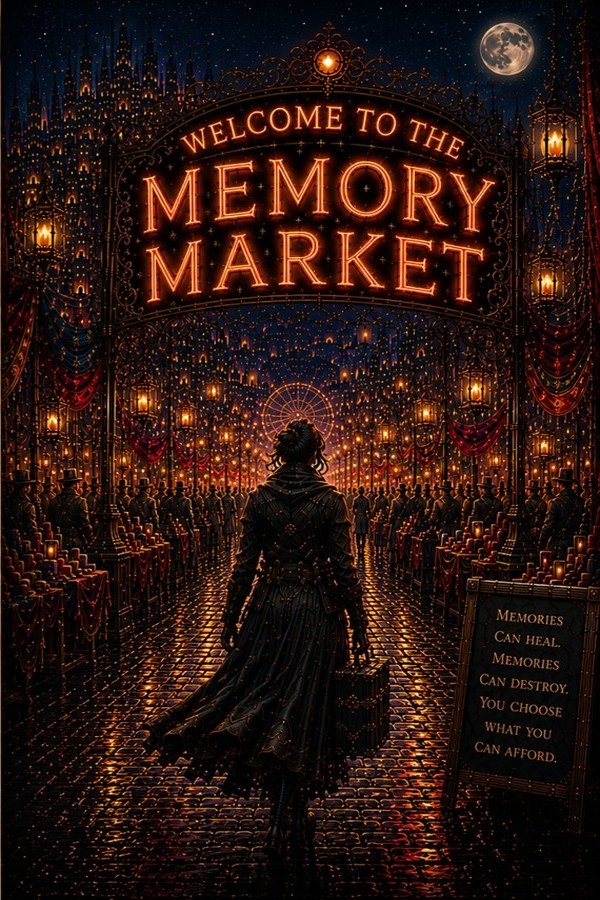
Chapter One
Wren Adaire bought and sold what other people could not carry.
Nine years she’d done it.
Nine years without a single broker on her row successfully disputing one of her valuations.
That was not luck.
It was Adaire.
The old brokers still said the name with respect. The younger ones said it like a challenge. Wren ignored both. A name could open doors, but it could not weigh grief. It could not taste a forgery. It could not keep your hands steady when a mother came to the felt with the last morning of her child’s life held out in her palm.
Her father had taught her that.
Not comfort.
Discipline.
She had been eight years old the first time he let her hold a memory. Small as a fingernail. Warm as breath. He put it in her hand and closed her fingers around it, gentle as a blessing.
“You don’t buy tears,” he told her. “You buy what comes after.”
She had not understood him then.
She understood now.
Grief moved fastest.
Joy held its value.
Regret was always overpriced.
She traded all of it.
A man’s worst afternoon.
A widow’s last conversation.
A wedding day that belonged to someone else.
She bought low from the desperate.
She sold high to the hungry.
She never flinched.
That, too, her father had taught her.
The memory lies, Wren.
The bleed never does.
Trust the bleed.
He had said it so often the words no longer came to her in his voice. They came as law.
She believed in the trade the way other people believed in God.
Forgetting was mercy.
Remembering was weight.
She had built her life on the difference.
It had been enough.
She believed every sale she had ever made.
She did not think, walking down to the pier, about the one she could no longer remember making.
The pier was old and the fog had come in.
It ran out into the evening on boards gone soft and grey with age, and the mist sat over it thick enough to swallow the far end, so that she seemed to be walking toward nothing at all—just a few more feet of wet plank and then white. The lamps along the rail wore halos. The air was cold and still and smelled of salt and rust and the green underneath of old wood. Somewhere out in the murk a bell-buoy she could not see knocked once, slow, and went quiet. There was no one else. There was never anyone else. The whole evening had the hush of a held breath.
She walked it the way she’d walked it a thousand times, her box held to her chest, her footsteps the only sound, the fog closing in soft behind her.
Hers was only one pier of thousands. Every shore had one, every city, every sleepless hour of the dark—a quiet traffic of people walking out into the fog with something to sell or something to find. She had stopped finding it strange. She supposed that was its own kind of loss.
At the end of the boards the mist went white and total, and there was nothing to see, and nothing to step onto, and that was the place.
She jumped.
It was not a fall and there was no water in it. It was the older thing—the letting-go, the crossing, the surrender that couldn’t be done by halves. Something left her on the way. It always did; she never knew quite what, and had long since stopped counting the cost. And the grey gave way—
—and opened on the Market, all at once and roaring.
It never closed. That was the thing the waking world could never quite hold onto about it. There were no hours, no opening, no end of the day—it simply was, always, the way a river is, and you came to it when the wanting got bad enough, to buy or to sell or to trade, at any hour of any night, and it was always there, always lit, always roaring, and it had never once been dark.
Then the smell reached her, the way it always did a half-second behind the sign, and that was how she knew she was truly back.
It came up thick and warm and total—tallow smoke and incense and crushed flowers, sweat and spilled wine and old wood, the green-brass tang of a thousand lanterns burning low, and under all of it, always, the sweetish underneath-smell of the goods themselves, of memory traded hand to hand, which she had never been able to describe to anyone who hadn’t breathed it and never had to describe to anyone who had. The air was close and heavy with it. It pressed on you like a held breath, like a room full of people all remembering at once. You did not get used to it. You only stopped noticing you hadn’t.
Below the sign, the city.
It rose out of the dark on every side, tier on tier, lantern on lantern, more than the eye could hold—a whole city built of wanting, awake at an hour the waking world never reached, and never anything but awake. Stalls bloomed down every lane like something gone to seed. Silk and smoke and beadwork. Voices from all directions at once—sell me your memory, buy your dream, I’ll take what hurts—a choir with a thousand throats and one appetite.
Wren did not look at it the way the new ones did.
She moved through it with her box and her trader’s eye, and read it the way you read a thing you’ve worked your whole life. She clocked the prices chalked on the boards and knew which were lies. Two lanes over a dream-merchant worked the crowd, lovely as a lit window, selling lives that had never happened to people who could no longer stand their own. She passed the grief-traders haggling over fresh widowhoods. She passed the long bright row where they sold first kisses and last words and a father’s pride and the day that changed everything, all of it weighed and tagged and waiting for a buyer who’d pay to feel something that was never theirs. She passed a hollowcheeked old woman at a brass scale under a banner that read MEMORIES WEIGHED HONESTLY, and knew for a fact the scale was rigged, and thought, without heat, that everyone’s was.
None of it moved her. She had handled too much of it. To Wren the Market was not a wonder and had not been for years. It was a workplace. She knew where the money was and she knew where the bones were buried, and most nights those were the only two things worth knowing.
Far down her own row, one banner always made her slow.
She did not slow tonight. She told herself she hadn’t seen it.
Her stall was where it always was, the felt laid out, the lamps already lit—and Odile, who’d spotted her half the lane off, was already up and out from behind the table with her arms wide open.
“There she is. There’s my girl.” The hug was complete and unhurried, rings and warmth and the smell of her, and for the whole length of it the roaring city went somewhere far away. Odile held her back at arm’s length, looked her over, found her wanting, said so with her whole face. “You came in looking like bad weather. Sit. Before you tell me a single thing, sit down.”
There was tea already waiting, steam off it in the lantern light. Of course there was. Odile had poured it before Wren had even cleared the lane, because Odile always knew, and that was the closest thing to being known that Wren let herself keep.
“Drink,” Odile said, folding Wren’s hands around the cup. “Then tell me who I have to ruin.”
And Wren—who had walked the whole way down believing every sale she’d ever made—sat in the one place in all that endless market that wanted nothing from her, and drank her tea, and almost felt like a person.
It was the tea that did it. It always was. The particular way Odile pressed a cup into her hands, both of hers folded around both of Wren’s—she had been doing it for so long that Wren had stopped feeling where it came from, the way you stop hearing a clock. But tonight, hollowed out and raw at the edges, Wren felt the old gesture land in her like a stone dropped down a well, and the well was deeper than she remembered, and at the bottom of it was her father’s felt.
She had been eight years old.
The Market had been smaller then, or she had been —either way it had not frightened her, because she had grown up in it the way other children grew up in the smell of bread or sawdust or the sea. Her father’s stall sat high on the good row, the Adaire row, and the old brokers nodded to him when they passed, and the young ones watched him work the way apprentices watch a master and pretend they aren’t. He had hands like the rest of him: broad, unhurried, certain. She used to sit under the table among the felt-rolls and watch those hands take grief off strangers all night long and never once shake.
And there had been the girl.
The girl was always there by then—a tall, dark, quick-eyed thing of seventeen, all wrists and rings and watchfulness, who had turned up one winter out of the traveling people with no parents and no trade and a tongue that could talk a Watcher out of his own name. Wren’s father had taken one look at her reading a mark’s face across the lane—reading it cold, for free, for the pleasure of being right—and he had done the thing he did exactly once or twice in his life: he had said, come here, girl, you’ve got the eye, I’ll teach you the rest, and a body has to eat. And that had been that. Odile had come to the Adaire felt the way weather comes, and never left.
She was already good. That was the thing Wren remembered—that Odile had arrived already able to do the half of the trade that couldn’t be taught, the reading, the feeling-out, the gypsy thing she’d been raised on; and what Wren’s father gave her was the other half, the discipline, the weighing, the law. Trust the bleed, he told her, the same as he told Wren, and Odile had laughed at him the first time and never laughed at it again.
“Come up here,” he said, that night. To Wren, not to Odile. “You’re old enough.”
Wren had come out from under the table. Odile had shifted to make room without being asked, and there had been a look on the older girl’s face that Wren was far too young to read and would not understand for thirty years—a kind of ache, watching the father bring his daughter up to the felt, watching the thing she herself had had to be rescued into being handed to a small girl simply because she was his. It was gone in an instant. Odile put it away the way she put everything away, somewhere behind the eyes, and made room, and smiled.
He took something from the lockbox. Small. A child’s first memory always was—nothing dangerous, nothing deep, a fingernail of feeling somebody two rows down had sold for the price of a meal. He held it out on his broad flat palm in the lantern light.
“Go on,” he said. “It won’t break you. Tell me what’s in it.”
Wren had looked at the small warm thing and been afraid.
“You hold it like this.” Odile’s hands, ringed and certain, closing gently over Wren’s, guiding them around it the way you’d teach a child to hold a bird. “Soft. You don’t grab. You listen. Like you’re catching something somebody whispered across a room.” Her voice had been very low, just for the two of them, under the father’s watching. “There. Feel that? That little warm thread under the picture? That’s the only true thing in it. The picture lies. The thread never does.” She had smiled, sidelong, at the man across the felt. “Your father taught me that. He’ll tell you he made it up. He didn’t. It’s older than him. But don’t tell him I said so.”
And Wren—eight years old, her best friend’s hands around hers, her father watching, the whole roaring Market gone soft and far away—had closed her small fingers around the memory, and listened, and felt the thread, and known, the way you know a true thing only once and spend the rest of your life chasing the knowing again.
“Joy,” she had whispered. “Somebody’s first snow.”
Her father had not smiled—he was not a smiling man —but something had moved through him, satisfaction or grief or both, and he had put his hand once on the top of her head, heavy and warm, and that was all, and that was everything.
He had been dead five years now. A year longer than the thing Wren could not remember—though she did not know yet that there had been anything to remember, did not know there had been a Bell, knew only that the felt had passed to her, and the row, and the name, and the creed—and the girl, grown now, still at her side, still folding both hands around both of hers and pressing the warmth into them, every single night, the way she’d been taught.
“You’ve gone somewhere,” Odile said now, watching her over the rim of the cup. The lanterns of the present Market came back up around them, the roar, the smoke. “Where’d you go?”
“Nowhere,” Wren said. “Drink my tea.”
But she did not let go of Odile’s hands, not right away, and Odile—who read everything—let her keep them, and said nothing, and for a moment the two of them sat in the noise of the place that had raised them both, holding on.
End of sample
Keep reading the story.
The complete book is available on Amazon.